








Reed Diffusers
12 termsA passive home fragrance device consisting of a vessel filled with scented liquid — a diffuser base mixed with fragrance oil — with reed sticks inserted to wick the liquid upward and disperse scent into the room by evaporation. No heat, no flame, no electricity required. Reeds point in multiple directions to disperse aroma throughout the space. Diffusers work continuously and last 2–4 months depending on vessel size, reed count, and room conditions.
The process by which fragrance molecules move from the reed tips into the surrounding air without any active energy source — no heat, electricity, or fan. Passive diffusion produces a subtler, more consistent scent than heat-based methods, and is gentler on fragrance molecules that may degrade at elevated temperatures. Reed diffusers, scentable beads, and potpourri all rely on passive diffusion.
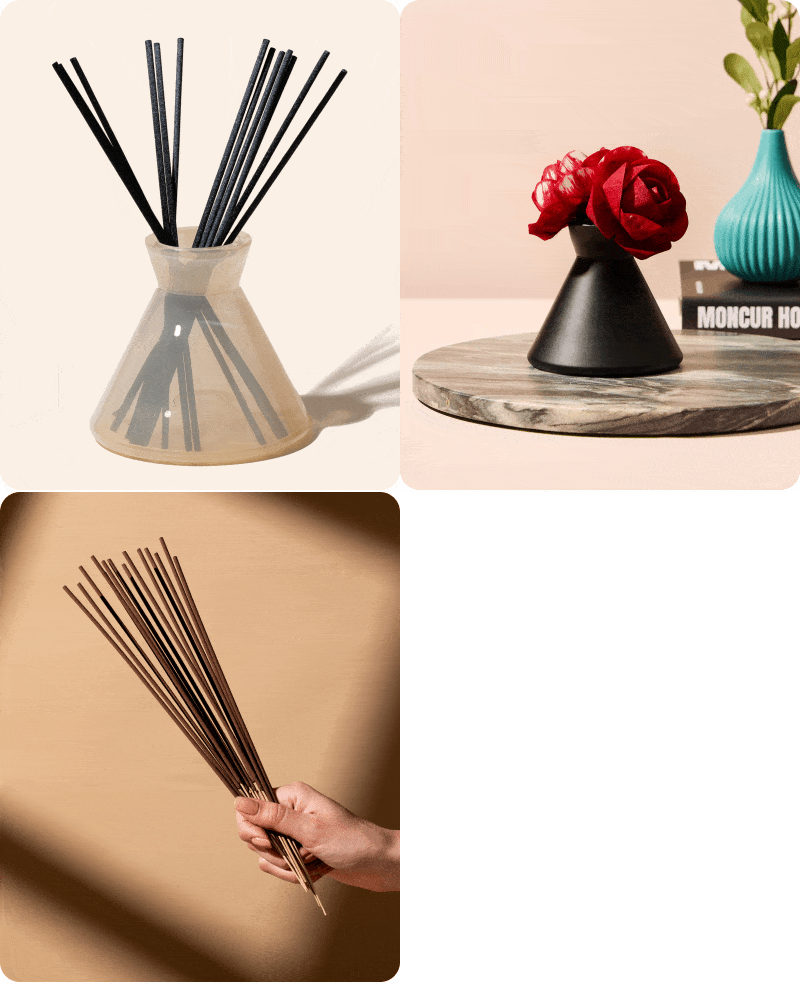
The container that holds the diffuser liquid — typically a glass bottle, ceramic vessel, or decorative jar with a narrow neck opening. The narrow neck is functional, not just aesthetic: it slows evaporation and controls how much scented air contacts the atmosphere at once, extending the life of the diffuser. makesy's Vella collection vessels are a popular choice, with approximately a 7oz total fill and a neck diameter sized for standard reed bundles.
The diameter of the vessel opening through which reeds are inserted. Neck opening size directly affects evaporation rate and throw: a wider neck exposes more surface area to air, increasing evaporation and scent throw but shortening diffuser lifespan. A narrower neck slows evaporation for a more subtle, long-lasting effect. Standard reed diffuser vessels have neck openings of 18–25mm — wide enough for a bundle of 10–15 reeds.
Inverting the reed sticks so the dry, exposed end is submerged in liquid and the freshly saturated end points upward. Flipping reeds temporarily intensifies scent throw as the newly dipped portion is heavily saturated with fragrance. makesy recommends flipping reeds every few days for increased fragrance throw — but with caution, as flipping too frequently depletes liquid faster. Flip over a sink or tray to catch drips.
The number of reed sticks placed in a diffuser vessel. More reeds = stronger scent throw but faster liquid depletion. Fewer reeds = subtler, longer-lasting fragrance. makesy recommends using 10–20 reeds per diffuser for optimal performance and longevity. Start with fewer reeds in smaller rooms and increase for larger spaces or when a stronger throw is desired.
How long a completed reed diffuser maintains active scent release. Typical lifespan is 2–4 months for a properly made 3–4oz fill. Longevity is affected by vessel fill volume, reed count, neck opening size, room temperature (warmer = faster evaporation), air movement (fans, HVAC, open windows accelerate evaporation), and whether reeds are flipped. A lower fragrance load and fewer reeds extend longevity at the cost of throw intensity.
The speed at which diffuser liquid is drawn up through reeds and released into the air. Evaporation rate determines scent throw intensity and product lifespan — a faster rate means stronger scent but shorter life. Factors affecting rate: ambient temperature, air circulation, reed count, reed material, neck opening width, and the viscosity of the diffuser base. Lower-viscosity bases (thinner liquid) wick faster; higher-viscosity bases (thicker) wick more slowly and last longer.
A bottle of pre-mixed or separate diffuser base and fragrance oil sold to refill an existing diffuser vessel when the original liquid is depleted. Refills are a high-margin repeat-purchase product for diffuser brands — a customer who loves the scent will buy the refill at near-full product price without needing the vessel again. Always replace reeds with new ones when refilling, as old reeds accumulate dust and residue that block their porous channels.
A cap, cork, or stopper that seals the diffuser vessel opening during shipping and storage to prevent spillage. Caps are removed and replaced with reeds when the diffuser is activated. Some premium diffuser products include a decorative metal collar that holds the reeds in position and elevates the aesthetic of the vessel opening.
The category of products designed to scent indoor spaces — including reed diffusers, candles, room sprays, incense, scentable beads, potpourri, wax melts, plug-in diffusers, and car fresheners. Reed diffusers and incense are two of the most popular home fragrance formats because they operate without electricity, work continuously, and serve as decorative objects as well as functional scent delivery systems.
Where in a room a reed diffuser is positioned for optimal scent distribution. Diffusers work best in areas with natural air circulation — near doorways, hallways, entryways, and bathrooms — where movement helps carry fragrance through the space. Avoid placing directly under heating vents (causes too-rapid evaporation) or in closed, stagnant rooms with no airflow. A diffuser in a bathroom foyer greets everyone who enters with fragrance — one of the most effective placements for a home or commercial property.
Diffuser Bases
10 termsThe carrier liquid that forms the majority of a reed diffuser's fill. The base makes fragrance oil viscous enough to wick slowly up the reeds and evaporate gradually over months rather than days. Without a proper base, undiluted fragrance oil wicks too rapidly, depletes quickly, and may not distribute evenly through the reeds. The base also determines the product's VOC content, shelf life, clarity, and compatibility with different fragrance oils.
makesy's 100% natural, 0% VOC diffuser base — the only fully VOC-free natural diffuser base available on the market. Formulated without phthalates, parabens, sulfates, petroleum, Prop 65 ingredients, or allergens. Vegan and GMO-free. Maximum fragrance load: 40%. Flash point: 200°F / 93°C. Paraben-free and allergen-free. Ideal for makers positioning their diffusers as natural, clean, or eco-conscious products.
makesy's proprietary coconut-infused diffuser base, exclusively available at makesy. Designed for unparalleled fragrance diffusion with an even, consistent dispersion of fragrance or essential oils. Flash point: 173°F / 78.3°C. VOC content: less than 1% with a maximum fragrance load of 50%. Paraben-free, vegan, allergen-free, and phthalate-free. The higher maximum fragrance load makes this base ideal for makers wanting an exceptionally strong scent throw.
Dipropylene Glycol — the traditional solvent used in both reed diffuser bases and incense making. In diffusers, DPG thins fragrance oil for reed wicking. In incense, DPG acts as the carrier that absorbs fragrance oil and holds it in the incense material for controlled slow release during burning. DPG is odorless, low-volatility, and mixes with both polar and non-polar fragrance compounds. The standard incense recipe uses a 1:1 ratio of DPG to fragrance oil.
How thick or thin a diffuser base is — its resistance to flow. Viscosity directly affects wicking speed: thinner bases wick faster and produce stronger initial throw but deplete more quickly. Thicker bases wick more slowly for a subtler, longer-lasting scent release. Temperature affects viscosity — bases thin out in warm rooms and thicken in cold, which changes diffuser performance seasonally. Testing in your intended selling environment is important.
The percentage of fragrance oil relative to the total diffuser fill volume. makesy recommends 20–25% fragrance oil to base for reed diffusers. The All-Natural Base supports up to 40% fragrance load; the Coco Purefuse base supports up to 50%. Higher fragrance loads produce stronger throw but also increase the product's VOC content. Always reference the IFRA safety sheet for your specific fragrance oil to stay within safe usage limits.
Whether a fragrance oil blends cleanly and stably with a given diffuser base — without clouding, separating, gelling, or discoloring. Not all fragrance oils are compatible with all bases at all percentages. High-vanillin fragrances can discolor bases to yellow or brown over time. Some heavy perfume-style fragrance oils thicken or separate in natural oil-based carriers. Always test new fragrance-to-base combinations before committing to a full production batch.
A liquid used to dilute and stabilize fragrance oil in a formulation. In diffusers, the carrier solvent (base) thins the fragrance and controls its evaporation rate. In incense, DPG is the carrier. In room sprays, ethanol (alcohol) is the carrier. In perfume, alcohol or a skin-safe carrier oil is used. The carrier solvent choice dramatically affects how fragrance is released, how long it lasts, and what claims can be made on the product label.
When a diffuser liquid that was initially clear turns milky or hazy over time or after mixing. Clouding is caused by fragrance oil compounds that are not fully soluble in the base at the chosen percentage, or by exposure to cold temperatures. While clouding doesn't necessarily affect scent performance, it is visually undesirable in clear glass vessels. Test for clarity at room temperature and at the coldest anticipated storage or display temperature before selling.
A family of organic compounds used as solvents and humectants in cosmetics, diffusers, and industrial applications. In diffusers, glycols (including dipropylene glycol, propylene glycol, and polyethylene glycol) are used as carrier solvents. They are water-soluble, low-volatility liquids that slow fragrance evaporation for longer product life. Not all glycols are equivalent — DPG is the standard for diffusers and incense; other glycols may perform differently in reed applications.
Reeds & Vessels
11 termsThe most common diffuser reed material — a natural, porous stick made from rattan palm with internal channels running lengthwise that efficiently wick diffuser liquid upward by capillary action. Natural rattan reeds outperform synthetic alternatives because their open-channel structure draws liquid more consistently and evenly. They are biodegradable, eco-friendly, and renewable. makesy sells rattan reeds in sets of 100 — use 10–20 reeds per diffuser.
Thinner, more flexible diffuser sticks made from willow wood or bamboo charcoal, offering a different aesthetic to traditional rattan reeds. Charcoal sticks are particularly popular for their sleek, dark appearance in minimalist and luxury diffuser styling. Their absorption and wicking profile differs slightly from rattan — typically thinner with a tighter grain — making them better suited for lighter, low-viscosity bases.
A diffuser stick made from manufactured fiber or polymer rather than natural plant material. Synthetic reeds offer consistent diameter and density but generally provide less efficient fragrance wicking than natural rattan, due to their more uniform (less porous) structure. Some synthetic reeds are designed to prevent clogging in fragrances with high synthetic compound content that can block natural rattan channels over time.
The physical force that allows liquid to flow upward through narrow channels in a material — the mechanism that makes reed diffusers work. Capillary action occurs because the adhesive force between the liquid and the reed's internal channel walls overcomes the downward pull of gravity. Smaller, more numerous channels (as found in natural rattan) create stronger capillary action and more efficient wicking than wider or fewer channels.
When the internal channels of a reed become blocked by residue, dust, evaporated solids from the fragrance oil, or degraded base compounds — reducing or stopping wicking. Signs of clogging: reeds appear saturated but the scent throw has noticeably weakened. Solution: replace reeds with new ones. Reeds have a finite functional life and should be replaced when a diffuser is refilled. Recommend customers replace reeds with each new fill.
A decorative flower cut and shaped from sola wood — the dried pith of the Aeschynomene aspera plant, also known as the tapioca or Indian cork plant. Sola wood is extremely lightweight, porous, and takes dye and fragrance beautifully. In reed diffusers, sola flowers are placed at the neck of the vessel as a decorative topper or floated lightly on the liquid surface. They can be dipped in diluted fragrance oil for a light supplemental scent source and are 100% natural and biodegradable.
The plant material used to make sola flowers and decorative diffuser accessories — harvested from the stem pith of the Aeschynomene aspera plant, native to India and Bangladesh. Sola wood is naturally white and cream-colored, extremely porous (making it excellent at absorbing fragrance), lightweight, and sustainably harvested. It can be left natural, dyed in any color, or left undyed to show its natural texture. A popular sustainable alternative to synthetic or real flower decorations in home fragrance products.
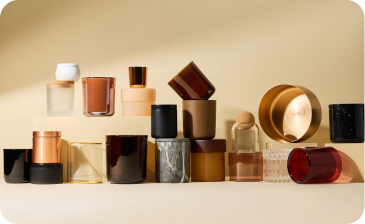
The container choices for reed diffusers span a wide range of materials and aesthetics. Common vessel materials: clear glass (shows the liquid and any color dye, elegant, widely used), frosted or colored glass (more opaque, allows limited color variation), ceramic (luxury look, completely opaque, can be designed with brand identity), and dark glass (protects fragrance from UV degradation). Vessel shape matters: taller, narrower vessels concentrate reed density and reduce evaporation surface; wider, shorter vessels increase surface exposure and stronger throw.
A dye or tint added to diffuser liquid for visual appeal in clear glass vessels. Diffuser colorants must be fully soluble in the base (no undissolved particles) and should not affect wicking, fragrance compatibility, or stability. Not all candle dyes are suitable for diffusers — use only dyes specifically formulated or tested for liquid diffuser applications. A small amount of colorant goes a long way; over-coloring can tint reeds and permanently stain vessels.
A decorative metal or wooden ring fitted over the neck of a diffuser vessel to frame the reed bundle, hide the vessel opening, and elevate the finished product's aesthetic. Diffuser collars are especially common in luxury and artisan diffuser lines — they communicate premium quality, make the reeds appear intentionally arranged rather than simply inserted, and distinguish a finished product from a DIY project. Available in gold, silver, black, and natural wood finishes.
The group of reed sticks inserted into a diffuser vessel as a set — typically 6–20 sticks arranged to fan outward from the vessel neck. How the bundle is arranged affects both function (reed distribution in the liquid) and aesthetics (the visual "crown" of the diffuser). Spreading reeds apart allows each one to wick independently and creates a more dramatic visual effect. Packing too many reeds together can slow individual wicking and reduce throw.
Fragrance & Scent
12 termsA fragrance oil formulated or tested for use in reed diffusers and other non-combustion home fragrance applications. Not all fragrance oils perform equally in diffusers — some have heavy molecular weights that don't evaporate efficiently from a base at room temperature, producing weak cold throw even at high fragrance loads. makesy carries a dedicated line of fragrance diffuser oils specifically selected for performance in reed diffuser and room spray applications.
The scent emitted by a fragrance product at room temperature without any heat source — the primary performance metric for reed diffusers. Unlike candles, which have both a cold throw (unlit) and a hot throw (lit), diffusers operate entirely in cold throw mode. A strong, pleasing cold throw is the single most important performance quality of a reed diffuser. Fragrance oils with high-volatility top notes (citrus, mint, light florals) tend to perform better in diffusers than heavy, complex basenote-dominant fragrances.
The strength and reach of fragrance emitted by a diffuser — how powerfully and how far the scent travels through a space. Unlike candle throw (which is heat-amplified), diffuser throw depends entirely on passive evaporation. Strong diffuser throw requires: a high fragrance load, high-volatility fragrance molecules, low-viscosity base, more reeds, good air circulation, and warmer ambient temperature. Diffusers work particularly well in bathrooms, foyers, and corridors where people regularly pass through.
How readily fragrance molecules evaporate into the air at room temperature. High-volatility molecules (top notes — citrus, light herbs, fresh florals) evaporate quickly and produce a strong immediate cold throw but fade faster. Low-volatility molecules (base notes — musks, woods, resins, vanilla) evaporate slowly and provide long-lasting subtle background scent but may be difficult to detect in cold throw applications. The best diffuser fragrances have a balanced volatility profile — enough top and mid-note character to be detectable, supported by lasting base notes.
Pure plant-derived aromatic compounds used in reed diffusers as an alternative to or blend with synthetic fragrance oils. Essential oils can be used directly in makesy's diffuser bases at the same 10–25% fragrance load recommendation. Essential oils vary widely in volatility — lighter citrus and mint essential oils throw strongly in diffusers while heavier resinous oils (patchouli, vetiver) may underperform. Essential oil diffusers appeal strongly to natural-label consumers but typically require higher usage rates than synthetic fragrance oils to achieve comparable throw.
The complete aromatic character of a fragrance across its three stages of evaporation — top notes (first impression), heart/mid notes (the body of the scent), and base notes (the lingering dry-down). In a diffuser, all three note layers are present simultaneously at varying intensities depending on each component's volatility. Understanding a fragrance's full scent profile helps predict how it will perform at room temperature, what customers will experience throughout the day, and how the scent character changes as the diffuser depletes.
The recommended fragrance oil percentage for reed diffusers is 20–25% of total liquid volume, though the IFRA safety sheet should always be consulted for any individual fragrance oil's safe limits. makesy's All-Natural Base supports up to 40% and the Coco Purefuse supports up to 50% maximum fragrance load. Start at 20% for testing and increase to 25% if stronger throw is desired. Never exceed the base's maximum fragrance load or the fragrance oil's IFRA limits.
The International Fragrance Association sets maximum usage limits for fragrance compounds across product categories, including air fresheners and room diffusers. Reed diffusers fall under IFRA Category 10 (air care products used in non-skin contact, indoor environments). IFRA certificates provided by fragrance suppliers specify maximum usage percentages per category — always verify your fragrance oil's IFRA limits for Category 10 before formulating and selling diffusers commercially.
makesy's curated collection of fragrance oils specifically selected and tested for performance in non-combustion formats — reed diffusers, room sprays, and scentable products. These fragrances are chosen for their room-temperature volatility profile, base compatibility, and IFRA Category 10 compliance, not just their scent quality. Not every fragrance in makesy's catalog performs equally in diffusers — the Fragrance Diffuser Oils collection is the shortcut to finding what works.
How strong a fragrance is perceived in a space — a function of fragrance concentration, volatility, room size, air circulation, and olfactory adaptation. Scent intensity in diffusers is adjustable: more reeds = stronger, fewer reeds = subtler. The same diffuser formula placed in a small bathroom will seem much more intense than in a large living room. When testing and sizing diffusers for a product line, test in a representative room size for the intended use case — not in a small enclosed space that will make any diffuser seem overpowering.
The phenomenon where continuous exposure to a scent causes the nose to stop detecting it — commonly called "going nose-blind." In a home with a reed diffuser, the occupants may stop noticing the scent entirely after a few hours, while guests entering the space immediately detect it. This is why reed diffusers are particularly effective for creating an impression for visitors (boutiques, hotel lobbies, spas) even when the occupants have habituated. Flipping reeds provides a fresh burst that momentarily overcomes olfactory adaptation.
makesy's curated collection of fragrance oils specifically selected for use in incense making — tested for performance when used with DPG as a carrier, soaked into blank incense sticks and cones, and burned. Not all fragrance oils translate well to incense — some produce unpleasant smoke notes on combustion; others lose their character entirely. The Fragrance Incense Oils collection identifies oils that maintain their scent integrity through the incense-making and burning process.
VOCs & Safety
9 termsOrganic chemical molecules that evaporate readily at room temperature and enter the air from products like reed diffusers, room sprays, and cleaning products. VOCs are the mechanism of scent delivery in diffusers — the fragrance molecules that reach your nose are VOCs. However, some VOCs are associated with indoor air quality concerns and are regulated in certain states. In the context of diffuser bases, a lower VOC percentage means fewer regulated chemical emissions, making the product more compliant and more marketable as a clean or eco-friendly product.
The percentage of a product's total weight that consists of volatile organic compounds. VOC content is calculated as a function of both the base's VOC percentage and the fragrance oil's VOC contribution at the formulated load percentage. A product's total VOC content = (Base VOC% × base weight fraction) + (Fragrance VOC% × fragrance weight fraction). For California compliance, the final product must be below 18% VOC. Using a 0% VOC base gives maximum flexibility with fragrance oil selection.
Compliance with California Air Resources Board regulations governing VOC content in consumer products. CARB sets product-specific VOC limits — for air fresheners (the category that includes reed diffusers), the limit is 18% VOC by weight. Non-compliant products cannot legally be sold in California. Since many national retailers and online marketplaces ship to California, CARB compliance is practically necessary for any maker selling nationally. Using a 0% VOC base like makesy's All-Natural Base provides a significant buffer for fragrance oil VOC contribution.
California's Safe Drinking Water and Toxic Enforcement Act, which requires businesses to warn consumers about products that contain chemicals known to cause cancer or reproductive harm. Some fragrance compounds found in reed diffusers and room sprays may trigger Prop 65 requirements. makesy's All-Natural Reed Diffuser Base explicitly contains no Prop 65 ingredients — a notable selling point for makers positioning their products as clean or natural. For custom fragrance blends, verify Prop 65 status with your fragrance supplier.
The chemical and particulate composition of air inside buildings, which affects occupant health and comfort. Reed diffusers and incense both release compounds into indoor air — fragrance molecules and, in the case of incense, smoke particles and combustion byproducts. High-quality, natural diffuser bases and IFRA-compliant fragrance oils minimize IAQ concerns. Incense should always be burned in well-ventilated spaces. Consumers with asthma, allergies, or respiratory sensitivities are a key segment to address clearly in product descriptions.
A formulation that does not contain phthalates — a class of chemical plasticizers historically used as fixatives in fragrance oils to help scent last longer. Phthalates have been associated with endocrine disruption and are regulated or banned in some consumer product categories in the EU and certain US states. All makesy fragrance oils and diffuser bases are phthalate-free — a key quality and marketing claim for makers targeting health-conscious consumers.
The lowest temperature at which a liquid gives off sufficient vapor to ignite when an ignition source is present. In diffuser formulation, flash point is a safety and shipping consideration — materials with flash points below 60°C (140°F) may be classified as flammable and subject to shipping restrictions. makesy's All-Natural Base has a flash point of 200°F/93°C and the Coco Purefuse has a flash point of 173°F/78.3°C — both are above common flammability thresholds and ship as non-hazardous materials.
A standardized document provided by ingredient suppliers that details a product's composition, physical and chemical properties, health hazards, safe handling procedures, and regulatory status. SDS documents for diffuser bases and fragrance oils contain VOC content, flash point, flash class, phthalate status, Prop 65 information, and IFRA compliance data — all the technical information needed to formulate compliant, safe products and make accurate label claims.
The air exchange conditions needed for safe and effective use of diffusers and incense. Reed diffusers operate safely in any normally ventilated indoor space. Incense requires better ventilation — burning incense produces smoke particles, carbon dioxide, and aromatic combustion byproducts that should not accumulate in enclosed spaces. Burning incense in a well-ventilated room (cracked window, working ventilation) and avoiding excessive incense use in small unventilated spaces is standard safety guidance for incense products.
Incense Sticks
11 termsA slender stick made from natural joss powder and bamboo, available pre-scented or unscented (blank) for DIY fragrance application. The bamboo core provides structure; the joss powder coating holds the fragrance and sustains the smoldering burn. Blank incense sticks are soaked in a DPG and fragrance oil mixture for 24 hours, then dried for another 24 hours before burning. makesy's incense sticks burn for 45–60 minutes and are made from natural materials for a clean burn.
An unscented incense stick or cone made from natural combustible material — joss powder, bamboo, charcoal, or a combination — with no fragrance added. Blank incense is the starting point for DIY incense making: the maker applies their own fragrance oil by soaking the blank in a DPG-fragrance mixture. Blank sticks allow complete fragrance customization and are the format makesy supplies for DIY incense production. Using blank incense with your own fragrance creates a product unique to your brand.
The combustible binding material that forms the body of an incense stick or cone — made from the dried and powdered bark and wood of the Litsea glutinosa (also called Indian laurel) or similar trees. Joss powder burns slowly and evenly, releasing the embedded fragrance as it smolders. It binds the incense shape together while maintaining a slow, consistent combustion rate. The quality of joss powder directly affects how evenly an incense stick burns and how cleanly the smoke presents.
The thin bamboo stick at the center of a traditional incense stick that provides rigidity and a holder for the joss powder coating. The bamboo core is what distinguishes a "stick" incense from a "masala" or "direct burning" incense — the bamboo must be left unscented and does not absorb DPG efficiently. When soaking blank sticks, only the joss powder portion (not the bamboo handle) is submerged in the DPG-fragrance mixture to avoid the bamboo core from disintegrating.
Dipropylene glycol acts as the carrier solvent in incense making — it absorbs fragrance oil and allows it to penetrate evenly into the blank incense material during the soaking period. DPG is used in a 1:1 ratio with fragrance oil (10 drops DPG : 10 drops fragrance oil is the standard recipe). DPG is odorless and low-volatility, meaning it doesn't contribute its own scent and burns away cleanly. Without DPG, undiluted fragrance oil does not penetrate blank incense material evenly and may not release scent smoothly during burning.
The process of submerging blank incense sticks or cones in a DPG-fragrance oil mixture to allow the incense material to fully absorb the scented liquid. Soaking time: 24 hours minimum. After soaking, sticks and cones are removed and laid flat on a clean, dry, non-absorbent surface to air dry for another 24 hours before they are ready to use or package. Insufficient soaking time produces weakly scented incense; insufficient drying time produces incense that smokes excessively when lit.
The duration a single incense stick burns from lighting to ash — typically 45–60 minutes for a standard-length stick. makesy's natural incense sticks burn for 45–60 minutes. Burn time varies with stick length, joss powder density, fragrance load, airflow, and how the stick is held (horizontal vs. angled). Higher fragrance loads can slightly extend burn time by adding combustible material; heavy fragrance loads may occasionally cause sticks to self-extinguish if the fragrance interrupts the burn path.
The residue left after an incense stick or cone has burned completely. Clean-burning incense produces a uniform, light grey or white ash that holds its shape (the "ash column") rather than falling in chunks. A perfect ash column — where the burned portion maintains its stick form all the way to completion — is a quality indicator of well-made, evenly-burning incense. An incense holder or ash catcher is essential for catching fallen ash and protecting surfaces.
A stand, tray, or vessel designed to hold incense sticks or cones upright during burning and catch falling ash below. Incense holders come in multiple forms: flat ash-catch boards with a narrow slot for the bamboo handle, ceramic boats with a channel for the stick, decorative burner boxes, and bowl-style holders for cones. Including a matching incense holder with a branded incense product elevates the gifting experience and creates a complete, product-complete offering.
Incense that contains its own combustible material (joss powder, charcoal, makko powder) and burns without an external heat source — the standard type for commercial stick and cone incense. Direct burning incense is lit, then blown out to smolder. This contrasts with indirect burning incense (like Japanese koh or resin incense), which does not contain combustible material and must be burned on a separate heat source (charcoal disc, electric incense heater). makesy's blank sticks and cones are direct burning incense.
The visible aromatic smoke produced by smoldering incense — a combination of combustion byproducts, fragrance molecules, and particulate matter. The quality, color, and density of incense smoke varies with the combustible base material, fragrance load, and burn conditions. Good quality incense produces a thin, steady plume of light, white or pale grey smoke. Excessive, black, or acrid smoke can indicate over-saturation with fragrance, poor-quality joss powder, or burning in low-oxygen conditions. Always burn incense in well-ventilated spaces.
Incense Cones
8 termsA conical incense form made from natural charcoal and bamboo powder, compressed into a triangular cone shape. Cones burn from the tip down — the narrow apex lights first, creating an inverted burn path that produces increasingly more surface area as it burns toward the wider base, intensifying scent throw over the burn duration. makesy's incense cones burn for 15–20 minutes — significantly shorter than sticks (45–60 min) but more concentrated in their scent release.
The direction a cone burns — from the narrow tip downward toward the wide base. This is the inverse of a candle burn: while a candle's flame burns away the top surface, a cone's smolder front moves progressively deeper into the wider portion of the cone, exposing more fragranced material as it burns. The result is a scent throw that intensifies through the burn, peaking just before the cone is fully consumed. Cones are more intense and shorter-burning than sticks of equivalent mass.
The combustible material composition of makesy's blank incense cones — natural charcoal powder and bamboo powder pressed into cone form. Charcoal provides the combustion fuel; bamboo adds structural integrity and a consistent burn rate. The charcoal-bamboo combination produces a relatively clean, low-smoke burn compared to charcoal-only cones. Unlike sticks, cones have no separate bamboo handle — the entire cone is combustible and absorbs fragrance throughout its volume.
The process of submerging blank incense cones in a DPG-fragrance oil mixture for 24 hours to allow full fragrance absorption throughout the cone's volume. Because cones are entirely combustible (no bamboo handle), the entire cone can be submerged — unlike sticks where only the coated portion is soaked. After soaking, cones are dried flat on a clean surface for 24 hours. Cones absorb fragrance at a slightly faster rate than sticks due to their denser charcoal-bamboo composition and lack of bamboo core.
A heat-resistant platform or vessel specifically designed to hold an incense cone upright during burning and safely catch ash below. Because cones produce a concentrated ash pile rather than the long column of a stick, cone holders typically feature a small raised platform or depression that centers the cone and allows ash to fall cleanly to a collection surface below. A cone holder is an essential companion product — a cone burning directly on a wooden surface will char or ignite it.
A specialty incense cone with a hollow channel drilled through the center, designed to create a "waterfall" smoke effect — where the dense, cool smoke flows downward through the hollow channel and cascades over the burner vessel rather than rising upward. Backflow cones require a specially designed backflow burner with a complementary hollow platform. The visual effect of smoke flowing down like water has made backflow incense and burners extremely popular in the home decor and wellness market.
The practical differences between incense sticks and cones for both the maker and the customer. Sticks: 45–60 minute burn time, longer and more diffuse scent release, requires a stick holder, bamboo handle limits full soaking. Cones: 15–20 minute burn time, more concentrated and intense scent release, requires a cone holder, entire form is combustible and fully soakable. Cones suit customers who want a shorter, more intentional fragrance ritual; sticks suit ambient, background scenting over a longer period.
The duration a single incense cone burns from tip to complete ash — typically 15–20 minutes for a standard-size cone. makesy's incense cones burn 15–20 minutes. Burn time varies with cone size, charcoal-bamboo ratio, fragrance load, and airflow. Unlike sticks, cones cannot be extinguished and relit easily once the conical shape is compromised — they are best treated as single-use burn items. The focused, shorter burn makes cones ideal for a before-bed ritual, meditation session, or creating an immediate atmosphere before a gathering.
Scentables & More
9 termsCeramic, silica gel, or polymer beads that absorb and slowly release fragrance oil over time — a flameless, reedless alternative to reed diffusers. Scentable beads are placed in decorative bowls, sachets, or mesh bags and fragranced by drizzling or soaking with fragrance oil or a diluted diffuser mixture. They work by passive evaporation from the bead surface. Popular for closets, drawers, cars, and bathrooms. makesy carries ceramic scentable beads as part of its home fragrance collection.
A hanging, vent-clip, or sachet fragrance product designed for use in vehicles. Car fresheners rely on passive evaporation of fragrance oil from an absorbent material — felt, wood, paper, or scented beads. As a product category for makers, car fresheners are high-margin, fast-reorder products that expand a candle or home fragrance brand into a new use environment. makesy carries supplies for DIY car freshener production as part of its scentables range.
A decorative mixture of dried botanicals, flowers, spices, wood chips, and other natural materials lightly fragranced with essential or fragrance oil and displayed in open containers to scent a room by passive evaporation. Potpourri is one of the oldest home fragrance formats — though less commonly made from scratch today, it remains popular for decorative gifting and seasonal home fragrance. Sola flowers, dried botanicals, and reed diffuser fragrance oils can all be used in potpourri production.
The practice of using aromatic plant compounds — primarily essential oils — for their perceived psychological and physiological wellness benefits. Aromatherapy is a key marketing and positioning angle for natural diffuser and incense products. Common aromatherapy claims for diffuser and incense products: lavender for sleep and relaxation, eucalyptus for respiratory clarity, peppermint for focus and energy, bergamot for mood elevation. Note: therapeutic claims about health outcomes require FDA regulatory consideration in the US — focus on atmosphere and sensory experience rather than clinical health claims.
Dried plant material — flowers, herbs, berries, leaves, bark, seed pods — used as decorative and occasionally functional additions to reed diffusers and scentable arrangements. Botanicals floating on the surface of a diffuser vessel or arranged around the neck elevate the visual presentation significantly. They can also contribute light natural fragrance as the diffuser liquid evaporates through them. makesy carries a range of botanicals suitable for home fragrance decoration and product styling.
Natural or synthetic mineral specimens used decoratively in home fragrance and wellness product lines — placed in diffuser vessels, alongside incense holders, or in scentable arrangements. Crystals align naturally with the wellness positioning of aromatherapy diffuser and incense products, particularly in the meditation, mindfulness, and self-care market segments. They add perceived value and visual premium to a diffuser product with minimal cost. makesy carries crystals and gemstones as part of its scentables collection.
Two complementary home fragrance formats that serve different use cases. Room sprays deliver an immediate, intense burst of fragrance on demand — great for instant atmosphere before a gathering, in bathrooms between uses, or as a linen refresher. Reed diffusers deliver a continuous, passive background scent that builds gradually over hours. Many brands sell both formats in the same scent, allowing customers to use the diffuser for ambient background fragrance and the room spray for an on-demand scent boost.
An electronic device that disperses essential oils or fragrance into the air using ultrasonic vibration (which creates a fine mist), heat, or evaporative fan technology. Electric diffusers are separate from reed diffusers — they require electricity and usually use undiluted essential oils or dedicated diffuser oils without a base. Reed diffusers and electric diffusers serve overlapping but distinct market segments: reed diffusers appeal to the home décor, gifting, and luxury fragrance market; electric diffusers to the wellness, aromatherapy, and essential oil community.
A packaged product bundle containing a finished diffuser plus complementary accessories — typically a reed bundle, an extra fragrance vial, sola flowers or botanicals, and occasionally an incense product in the same scent. Diffuser gift sets are one of the highest-value SKUs in the home fragrance category, particularly at holidays. A well-composed gift set commands a premium price — the total perceived value exceeds the sum of parts when the components are harmoniously packaged. Building a gift set strategy into a diffuser brand from the start is one of the most effective margin-expansion moves available.